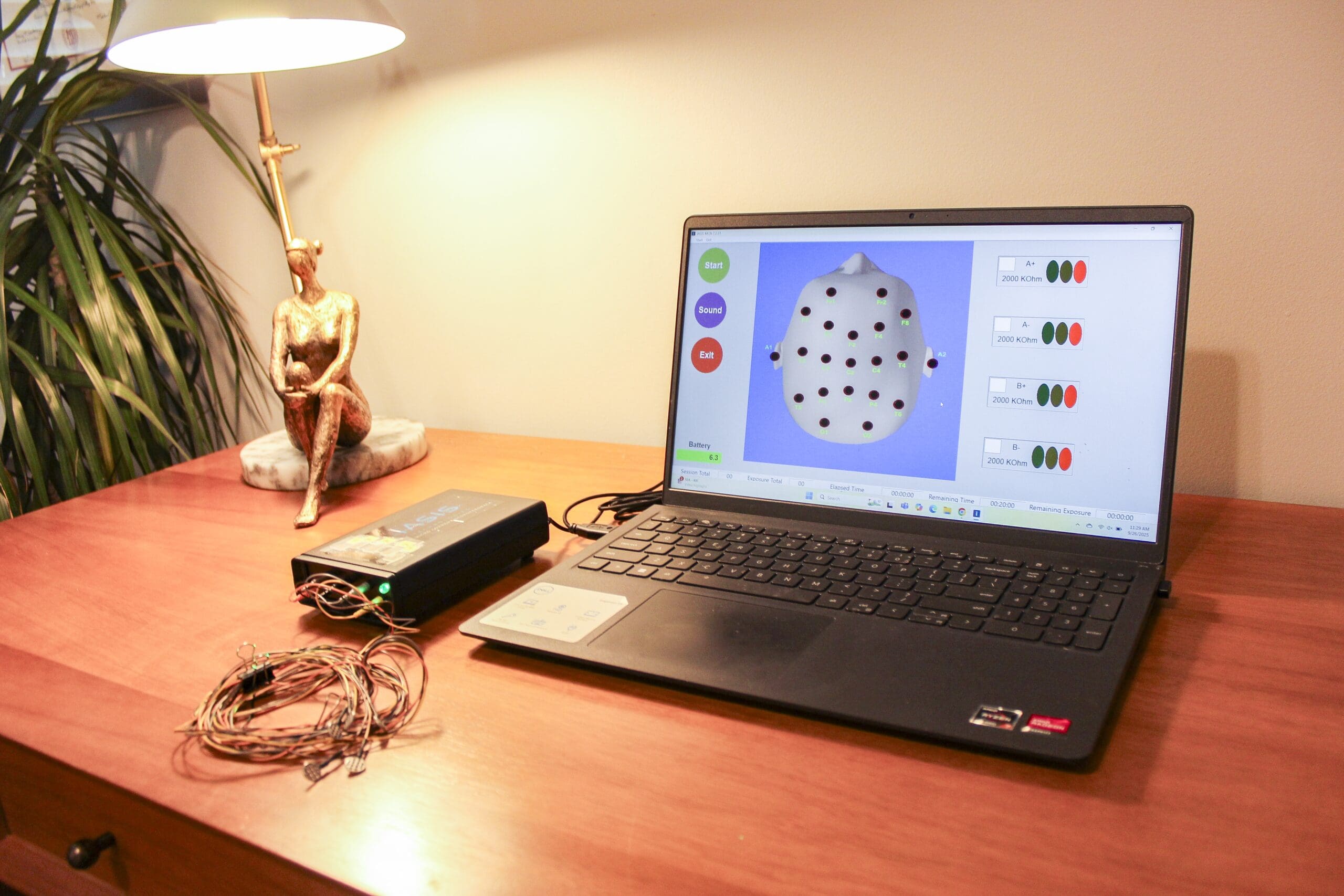
Let me introduce you to the therapy tool that sounds like science fiction but is actually just really good neuroscience: microcurrent neurofeedback (MCN).
If you’re exhausted from trying every anxiety management technique under the sun—meditation apps, breathing exercises, therapy, maybe even medication—and you’re still feeling like your nervous system has a mind of its own (spoiler: it does), neurofeedback for anxiety might be the missing piece.
What Is Microcurrent Neurofeedback?
Microcurrent neurofeedback is a non-invasive brain training technique that helps your nervous system “reset” stuck patterns. Think of it like a software update for your brain’s operating system.
Here’s the simple version: tiny sensors are placed on your scalp to read your brainwaves. The system detects patterns associated with dysregulation (like chronic anxiety), and sends back an extremely low-level electrical signal—so subtle you can’t feel it—that encourages your brain to shift out of those stuck patterns.
You literally just sit there. The technology does the heavy lifting.
No effort required. No homework. No “practice your breathing” lectures. Just your brain getting gentle feedback about its current state and an opportunity to reorganize itself.
How Neurofeedback for Anxiety Works
Your brain operates via electrical signals between neurons. When you’re anxious, certain patterns of electrical activity dominate—usually involving overactivation in areas responsible for threat detection and emotional reactivity.
Traditional neurofeedback trains your brain to shift these patterns through conscious effort and repetition (think “operant conditioning for your brain”). It works, but it takes 20-40 sessions and requires active participation.
But microcurrent neurofeedback works differently.
MCN doesn’t train your brain to do anything. Instead, it gives your brain information about its current electrical patterns. When your brain receives this feedback (via those tiny microcurrent signals), it has the opportunity to self-correct and move toward more optimal functioning.
It’s like holding up a mirror to your brain. Once it sees what it’s doing, it can adjust—kind of like how you automatically fix your posture when you catch your slouched reflection in a mirror.
Why Neurofeedback Works for Anxiety
- Your anxious brain is stuck in a pattern: Anxiety isn’t just psychological—it’s a specific pattern of brainwave activity. MCN helps interrupt that pattern.
- Less conscious effort required: Unlike therapy or meditation, you don’t have to “do” anything during MCN. Your brain does the work automatically when given the right feedback.
- Addresses the root, not just symptoms: MCN doesn’t mask anxiety; it helps your brain shift out of the dysregulated state creating the anxiety in the first place.
- Works with other treatments: MCN enhances the effectiveness of therapy, medication, and other interventions. It’s not either/or; it’s both/and.
- Relatively quick results: Many people notice shifts within 3-5 sessions, though optimal results typically require 10-20 sessions.
What Anxiety Issues Does Neurofeedback Address?
MCN can be effective for various anxiety presentations:
- Generalized anxiety disorder (GAD): That constant background hum of worry and tension that never fully goes away.
- Panic attacks: The sudden surge of intense fear and physical symptoms that feel like you’re dying.
- Social anxiety: The overwhelming fear and self-consciousness in social situations.
- Performance anxiety: Anxiety specifically triggered by situations where you’re being evaluated or observed.
- Health anxiety: Persistent worry about having or developing serious illness.
- Trauma-related anxiety: Anxiety stemming from past traumatic experiences, including PTSD.
- Insomnia related to anxiety: When an overactive, anxious brain won’t let you sleep.
What to Expect During MCN Sessions
- Initial assessment: We’ll talk about your anxiety symptoms, history, and goals. I’ll explain how MCN works and answer your questions.
- The session itself: You sit comfortably (you can even close your eyes or zone out). I place small sensors on your scalp and behind your ears—this doesn’t hurt and there’s no sensation from the microcurrent.
- Duration: Sessions typically last 30 minutes. You can read, listen to music, or just relax. Some people fall asleep.
- Frequency: Usually weekly sessions, though we often start with twice weekly for faster results.
- What you might notice during: Most people feel relaxed during sessions. Some notice a subtle shift in their thinking or mood. Others feel nothing during the session but notice changes later.
- After effects: Some people feel immediately calmer or more clear-headed. Others notice gradual improvements over several sessions. Occasionally people feel temporarily more activated or emotional as their brain reorganizes—this is normal and typically passes quickly.
The Science Behind Neurofeedback for Anxiety
Neuroplasticity is the foundation: Your brain can change its patterns throughout your lifetime. MCN leverages this capacity by providing the feedback your brain needs to shift out of anxious patterns.
Brainwave patterns matter: Anxiety is associated with specific brainwave patterns—often excessive high-frequency beta waves and insufficient alpha waves (associated with relaxed alertness).
Self-regulation gets easier: As your brain practices shifting out of anxious patterns during MCN sessions, this capacity generalizes to daily life. Your brain gets better at self-regulating.
The autonomic nervous system responds: MCN doesn’t just affect brainwaves—it influences your entire nervous system, helping shift you out of chronic fight-or-flight mode.
Research supports it: Studies show neurofeedback can reduce anxiety symptoms, improve sleep, decrease depression, and enhance overall functioning. MCN specifically shows promise for faster results with less required effort.
Benefits of Microcurrent Neurofeedback for Anxiety
Reduced baseline anxiety: Many people report their general anxiety level decreases—the constant background tension lessens.
Fewer panic attacks: Both frequency and intensity of panic attacks often decrease.
Improved sleep: Anxious brains that won’t shut down at night often respond beautifully to MCN.
Better stress resilience: You might still encounter stressors, but you bounce back faster and handle them with less overwhelm.
Enhanced emotional regulation: It’s easier to manage emotions without being completely hijacked by them.
Clearer thinking: The mental fog and racing thoughts that often accompany anxiety can clear.
Complement to other treatments: MCN often makes therapy more effective and can sometimes allow medication reduction (always consult your prescriber).
Minimal side effects: Unlike medication, MCN has virtually no side effects for most people.
Who Is a Good Candidate for MCN?
MCN works well for people who:
- Haven’t found sufficient relief from traditional anxiety treatments
- Want a non-medication approach or complement to medication
- Are willing to commit to multiple sessions (it’s not a one-and-done)
- Have anxiety related to nervous system dysregulation
- Want something that doesn’t require homework or practice
- Are curious about neuroscience-based approaches
MCN might not be the best fit if:
- You’re looking for immediate, one-session relief
- You have certain medical implants (pacemakers, etc.)
- You have active seizure disorders (though sometimes it’s still okay with clearance)
- You’re not willing to commit to a series of sessions
MCN vs. Traditional Neurofeedback
Traditional neurofeedback requires active participation, typically 20-40+ sessions and conscious effort to train specific brainwave patterns. It’s highly effective but time-intensive.
Microcurrent neurofeedback is passive, often requiring fewer sessions (12-20 for optimal results), and no conscious effort is required. Your brain does the work automatically.
Both are evidence-based. MCN is often faster and easier, which is why I offer it as an option for anxiety treatment.
Combining MCN with Other Therapies
MCN isn’t a replacement for therapy—it’s an enhancer.
MCN + EMDR: Calm your nervous system with MCN, then do trauma processing with EMDR. The combination is powerful.
MCN + Somatic therapy: MCN helps regulate the nervous system, making somatic work more accessible and effective.
MCN + Breathwork: Both work with nervous system regulation but through different mechanisms. Together, they’re even more effective.
MCN + Medication: MCN can enhance medication effectiveness and sometimes allows for dose reduction (with prescriber guidance).
MCN + Lifestyle changes: As your brain becomes more regulated, healthy habits like exercise, sleep, and nutrition become easier to maintain.
Real Talk: Is MCN Right for Your Anxiety?
MCN isn’t magic (though it can feel that way sometimes). It’s neuroscience. It works by giving your brain the opportunity to shift out of stuck patterns.
Will it cure your anxiety in one session? No. Will it work for everyone? Also no—though it has a high success rate for anxiety.
What MCN offers is a neurobiological intervention that addresses anxiety at the brain level, not just the symptom level. It’s particularly valuable for people whose anxiety hasn’t fully responded to traditional approaches or who want a non-medication option.
The clients I see who benefit most from MCN are those who are committed to the process, willing to do multiple sessions, and curious about addressing their anxiety from multiple angles.
Getting Started with MCN for Anxiety
If you’re interested in trying MCN:
- Schedule a consultation: We’ll discuss whether MCN is appropriate for your specific situation.
- Commit to a series: MCN works best with consistency. Plan for at least 12 sessions to see optimal results.
- Keep other supports in place: Continue therapy, medication, or other treatments while adding MCN.
- Notice changes: Keep track of your anxiety symptoms, sleep, mood, and overall functioning as we work.
- Adjust as needed: We’ll modify the frequency and approach based on your response.
Why Try Neurofeedback for Anxiety
If you’re tired of anxiety running your life and traditional approaches haven’t been enough, MCN offers a different pathway to relief. It’s not about trying harder, breathing deeper, or thinking more positively (though those things have their place).
MCN works at the level of brain patterns—the electrical activity that underlies your anxious feelings and thoughts. By helping your brain shift out of dysregulated patterns, MCN can reduce anxiety from the inside out.
No effort required. Just your brain, getting the feedback it needs to finally calm down.
Ready to explore if MCN might help your anxiety? Let’s talk about whether this approach aligns with your needs and goals.
I offer IASIS Microcurrent Neurofeedback alongside EMDR, somatic therapy, and other evidence-based approaches for anxiety and trauma. Interested in learning if MCN is right for you? Reach out to schedule a consultation.

Hi, I’m Christina Wolverton, better known as ‘Nina’ and I’m a licensed professional counselor, somatic therapist and the director of Reise Counseling in Atlanta, Georgia. I started this counseling practice to provide holistic and integrative mental health support to those experiencing trauma, loss, change, chronic stress and pain.
I am constantly looking for ways to challenge myself, either physically, emotionally, or intellectually and I try to keep informed on new research and emerging evidence that can benefit my clients. Here, you’ll find resources related to mental health, self care practices, nervous system regulation and the ways that different therapies may benefit you. Welcome!
April 22, 2026